
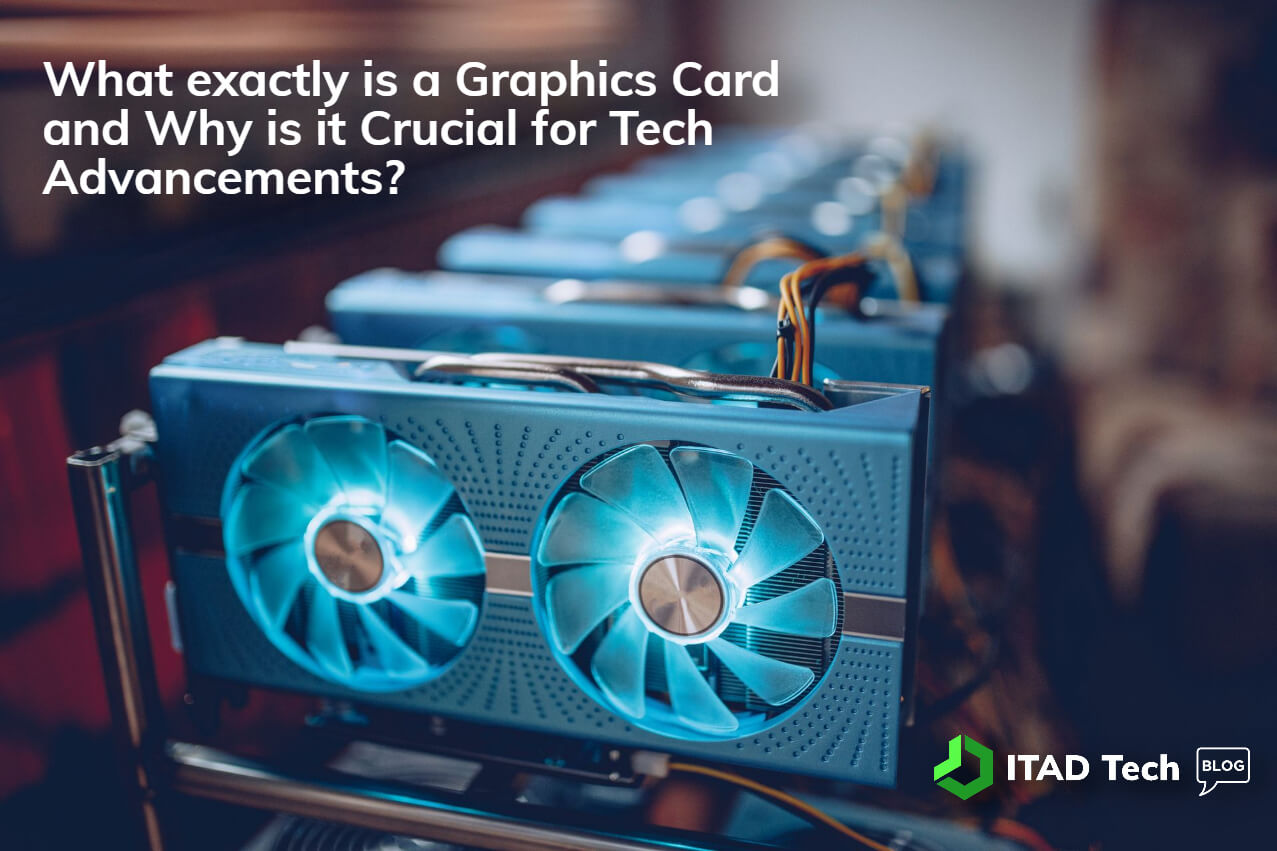
What exactly is a Graphics Card and Why is it Crucial for Technological Advancements?
What exactly is a Graphics Card and Why is it Crucial for Technological Advancements?
Graphics cards, also known as GPUs (Graphics Processing Units), are specialized electronic circuits designed to accelerate the creation and rendering of images, animations, and videos. While originally created for gaming and visual applications, GPUs have evolved into powerful computational engines that now drive advancements in various fields, including artificial intelligence (AI), data analysis, and high-performance computing.
Understanding Graphics Cards
A graphics card is essentially a dedicated piece of hardware that handles tasks involving massive amounts of parallel processing. Unlike CPUs (Central Processing Units), which are optimized for sequential processing, GPUs excel at performing many operations simultaneously. This capability makes them indispensable for tasks that involve large datasets and complex calculations.
A typical graphics card consists of several key components:
- GPU Chip: The core processor that handles graphical computations and data parallelism.
- VRAM (Video Random Access Memory): Specialized memory for storing textures, frame buffers, and data needed for rendering.
- Cooling System: To manage the intense heat generated by high-performance processing.
- Interfaces: Connections to communicate with the motherboard and display devices.
Why Are Graphics Cards Transformative?
- Advances in AI and Machine Learning: GPUs have revolutionized machine learning by significantly accelerating training processes. Neural networks, the backbone of AI, require billions of matrix operations. GPUs’ parallel processing capability makes them ideal for handling these tasks, reducing the time it takes to train models from weeks to hours.
- Data Centers and Cloud Computing: Modern data centers increasingly rely on GPUs to power workloads like predictive analytics, natural language processing, and video transcoding. By offloading these tasks to GPUs, data centers achieve higher performance and energy efficiency compared to relying solely on traditional CPUs.
- Scientific Research: Fields such as genomics, climate modeling, and computational physics leverage GPUs to process and analyze massive datasets. For example, GPUs enable faster protein folding simulations, which are crucial for drug discovery and understanding diseases.
- Gaming and Content Creation: While GPUs’ roles have expanded, their original purpose—delivering high-quality graphics for gaming and media—remains vital. GPUs allow for real-time ray tracing, 4K resolutions, and lifelike visual effects, pushing the boundaries of immersive experiences.
- The Rise of Edge Computing: With the proliferation of IoT devices, GPUs are now deployed at the edge—closer to where data is generated. This enables real-time processing for applications like autonomous vehicles, smart cities, and augmented reality.
The Road Ahead
Graphics cards are no longer just tools for gamers; they are the backbone of cutting-edge technology. As GPUs continue to evolve, they will play an even more significant role in enabling breakthroughs in AI, cloud computing, and scientific research. From rendering lifelike virtual worlds to solving humanity’s most pressing problems, the versatility and power of graphics cards are shaping the future of technology.